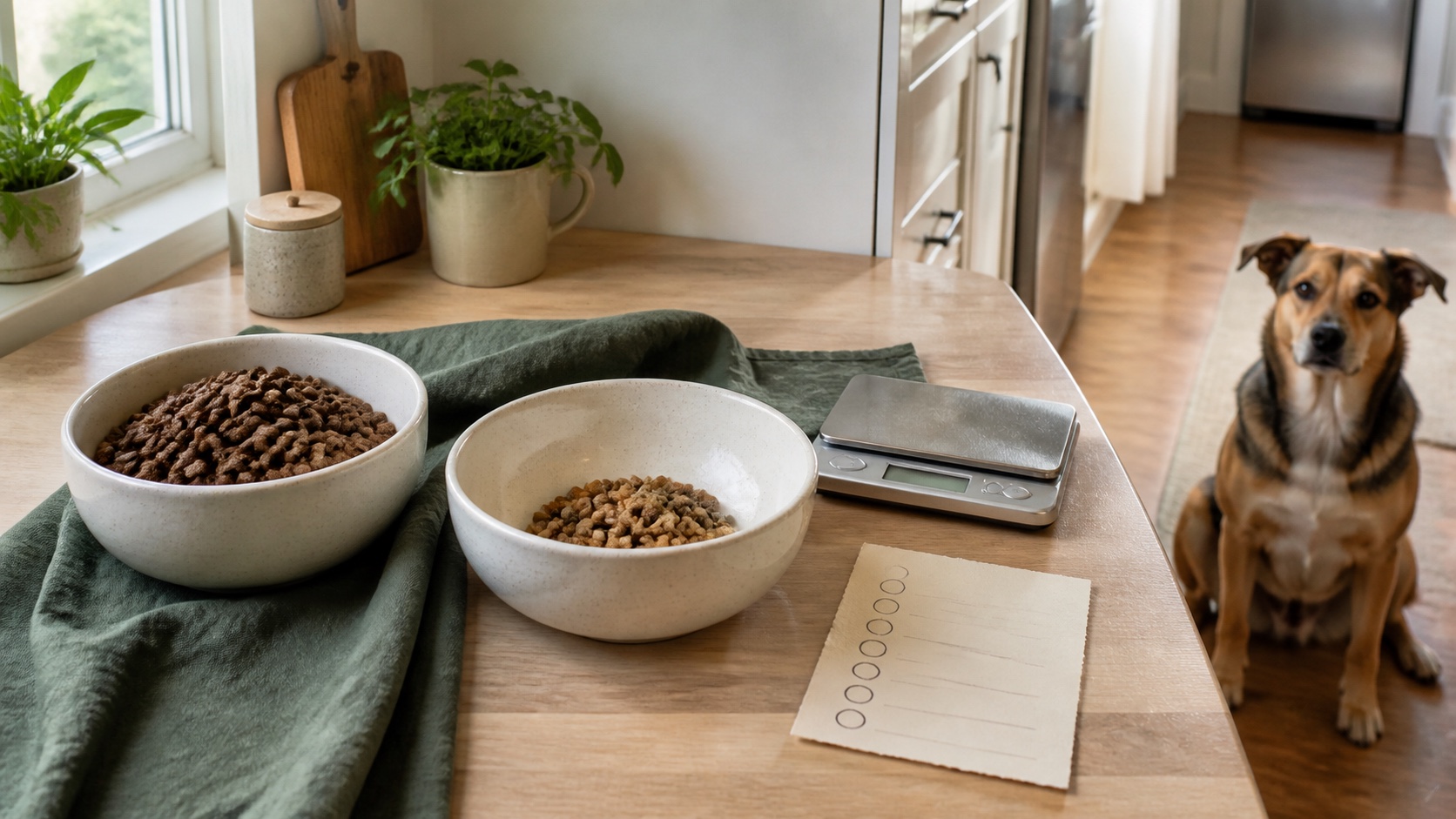
A food change is not a personality test. It is a small clinical experiment you run at home: one new variable, a measured mix, and a record of what the dog’s body does next. The internet will sell you a seven-day miracle and a brand story. Your dog needs a slower, more honest method.
This guide is for a healthy dog whose veterinarian has not prescribed a therapeutic diet. It will not diagnose allergy, intolerance, pancreatitis, or heart disease. It will help you choose a food worth switching to, change it without losing the plot, and know when the experiment should stop.
First decide whether a change is even the right job
People change food for reasons that range from useful to fashionable. Useful reasons include a veterinary recommendation, a confirmed food recall, a life-stage mismatch (a puppy still growing on adult food, or an adult still on growth food), a body-condition problem the current diet is not helping, or a dog who is simply not eating the food in front of them. Fashionable reasons include a new bag design, a neighbor’s anecdote, or a claim that a single ingredient is either magic or poison.
The American Animal Hospital Association’s 2021 nutrition guidelines are blunt on one common mistake: there is no AAFCO nutrient profile for “senior,” and an older dog who is doing well on a complete adult diet does not automatically need a new bag because a birthday passed. Change because the individual dog needs something the current food is not providing, not because the calendar or the marketing department said so.
If the current food is a veterinary therapeutic diet, stop here and call the prescribing veterinarian before you open anything else. Those diets are tools, not preferences. Swapping them because a friend prefers a different protein, or because the bag is expensive, can undo the reason the diet was prescribed.
Choose the food before you choose the schedule
A careful transition cannot rescue a poorly chosen diet. Before you mix a single cup, do the unglamorous work of reading the label and asking the company questions that marketing copy cannot answer.
The World Small Animal Veterinary Association’s Global Nutrition Committee asks owners and veterinary teams to look past words such as “holistic” and “premium,” which are unregulated and nutritionally empty. What matters more:
- Does the company employ a full-time nutritionist with a PhD in animal nutrition or board certification from the American College of Veterinary Nutrition or the European College of Veterinary and Comparative Nutrition? Consultants are not the same as staff.
- Who actually formulates the recipe? Formulation is a technical job. It is not taught as a complete skill in ordinary veterinary school, and it is not a hobby.
- What quality-control work is done on ingredients and finished product? WSAVA specifically names ingredient validation, finished-diet nutrient analysis, toxicology, bacteriology, and shelf-life screening.
- Has the company published or sponsored nutrition research in peer-reviewed journals? They are not required to. When they have, it is one signal of seriousness.
- Can you reach a person who will give typical nutrient analyses, not just the guaranteed analysis on the bag?
If a manufacturer cannot or will not answer those questions, WSAVA’s advice is simple: be cautious about feeding the brand.
Then read the nutritional adequacy statement. The U.S. Food and Drug Administration explains that “complete and balanced” is not a vibe. In the United States it means the food either meets an AAFCO Dog Food Nutrient Profile or has passed an AAFCO feeding trial. The statement should match the dog in front of you: growth, adult maintenance, or all life stages. Treats, toppers, broths, and “foods” labeled for intermittent or supplemental feeding are not a meal plan. AAFCO also notes that feeding directions are required on most complete-and-balanced foods; they are a starting point, not a personality.
Calorie density is the quiet trap. One cup of the new food may contain far more, or far less, energy than one cup of the old food. Deborah Linder, a board-certified veterinary nutritionist at Tufts, walks owners through this math because volume is a terrible proxy for energy. Write down the old food’s kcal per cup or can, the new food’s kcal per cup or can, and the daily amount your veterinarian wants the dog to eat. If you do not have that number, start from the new bag’s feeding table for the dog’s current weight and body condition, then adjust with the scale and a body-condition check rather than the dog’s opinion of the bowl.
One medical uncertainty deserves a quiet paragraph
Since 2018, FDA’s Center for Veterinary Medicine has investigated reports of dilated cardiomyopathy in dogs eating certain diets, many labeled grain-free and many with peas, lentils, or other pulses high on the ingredient list. The agency has been careful: it has not proved that any one ingredient causes the disease, it has received reports on both grain-free and grain-containing foods, and as of its December 2022 update it did not intend to issue further public updates until it had meaningful new science. What FDA has said clearly is that diet-associated DCM appears to be a complex, possibly multifactorial problem, and that owners should work with their veterinarian—who may consult a board-certified veterinary nutritionist—before making diet changes for a dog with heart disease or unexplained lethargy, cough, breathing difficulty, or collapse.
That is not an instruction to panic-switch every bag in the house tonight. It is a reason to prefer companies that can answer the WSAVA questions, and a reason not to treat “grain-free” as a health claim.
The Hold-and-Advance Ladder
Most veterinary nutrition sources recommend a gradual mix over at least a week. Tufts’ Petfoodology, written by a diplomate of the American College of Veterinary Nutrition, recommends increasing the new food over a minimum of seven days and notes that some pets tolerate a same-day swap while others need four to six weeks. Ontario Veterinary College’s pet-nutrition service describes a typical 7-to-10-day window and a longer one for sensitive dogs. None of those sources award a prize for finishing on day seven.
The calendar is the wrong instrument. The right one is a ladder you climb only when the current rung is comfortable.
The Hold-and-Advance Ladder
| Rung | Mix (by calories, not cups) | Advance when |
|---|---|---|
| 0 | 100% old food | You have recorded a two-day baseline of appetite, stool, vomiting, energy, and itch. |
| 1 | About 90% old / 10% new | Stool stays near baseline, appetite is steady, the dog is itself. |
| 2 | About 75% old / 25% new | Same. |
| 3 | About 50% / 50% | Same, for at least two meals, preferably a full day. |
| 4 | About 25% old / 75% new | Same. |
| 5 | About 10% old / 90% new | Same. |
| 6 | 100% new | You keep observing for several more days. The experiment is not over when the old bag is empty. |
How to use it:
- Hold at the current rung for at least one full day, longer if the dog is historically sensitive, very small, very old, or already has a delicate gut.
- Advance one rung only if appetite, stool, energy, and comfort look like the baseline, or like a mild, brief softening that is already improving.
- Step back one rung if stool loosens more than mildly, gas becomes marked, the dog vomits, or appetite drops. Stay there until the dog is comfortable, then try the next rung again more slowly.
- Stop the experiment and call the veterinarian if the dog has repeated vomiting, liquid diarrhea, blood in vomit or stool, pain, lethargy, refusal to eat, or any sign that worries you. Tufts is explicit: those signs may mean the new food is a poor match, something else is going on, or the dog needs supportive care.
A typical healthy dog may move one rung a day and finish near day seven. That is a common pattern, not a rule. A historically sensitive dog may spend three days on rung 2 and a week on rung 3. There is no moral content in that pace.
Measure by calories when you can. If the old food is 400 kcal per cup and the new food is 300, a “half and half” bowl that looks even is not even. A kitchen scale is more honest than a measuring cup. If you must estimate, stay conservative: it is safer to under-advance than to dump a calorie-dense kibble into a small stomach.
Keep the rest of the experiment quiet
A food change is one variable. The week you start a new bag is a poor week to add a new treat brand, a new chew, a new table-scrap habit, a probiotic you read about, or a sudden jump in exercise. If something goes wrong, you will not know which change caused it.
WSAVA and AAHA both treat extras as a minority of the day’s energy. Treats, training food, dental chews, and “just a bite” should stay under about 10 percent of daily calories so the complete diet can still do its job. If you use food for training during the transition, use pieces of the new kibble, or a treat the dog already tolerated on the old diet, and subtract those calories from the bowl.
Body condition is part of the plan. WSAVA publishes a nine-point body-condition score for dogs; a nutritional assessment, including body and muscle condition, is supposed to happen at veterinary visits across the dog’s life. You do not need to diagnose obesity at home, but you can notice whether the waist is disappearing or the ribs are getting too easy to count, and you can bring that observation to the clinic instead of guessing a new cup amount from social media.
What you should actually write down
Memory is a poor stool chart. For each day of the transition, record five things in plain language:
- Appetite. Ate promptly, grazed, left food, or refused.
- Stool. Formed, soft-formed, cow-pat, liquid; any mucus or blood; how many times.
- Vomiting or retching. Number of episodes, what came up, whether the dog was otherwise well.
- Energy and comfort. Normal, quiet, restless, painful when picked up or walking.
- Skin and ears. New itch, face-rubbing, or ear-scratching is not proof of allergy, but it is worth dating.
Tufts notes that some soft stool can be ordinary during a change, and that “loose” means different things in different households. If you and your veterinarian use a numbered stool chart, so much the better. If you do not, write what you saw, not a diagnosis.
Photos of stool and a short video of the dog after a meal are more useful than the sentence “he seems off,” provided you can take them without distressing the dog.
When to pause, and when to call
Pause and hold the last comfortable rung for mild, brief softening in an otherwise bright dog. Stretch the calendar. Do not add a third food to “help.”
Call the veterinarian the same day for repeated vomiting, liquid diarrhea, blood, a painful or bloated abdomen, marked lethargy, refusal to eat, or any combination that would worry you if there had been no diet change. Cornell’s Riney Canine Health Center treats repeated vomiting or diarrhea in a 24-hour period—especially with blood, lethargy, or refusal to eat—as a reason to seek care, diet change or no diet change. Puppies, seniors, and dogs with existing disease have less reserve; do not wait them out because a blog said seven days.
Unproductive retching with a tight or swelling belly is not a transition problem. The American College of Veterinary Surgeons describes gastric dilatation-volvulus as a rapidly progressive, life-threatening emergency. That dog needs a hospital, not a slower mix.
Special cases without turning them into folklore
Puppies still growing need a food with a growth or all-life-stages adequacy statement. Large- and giant-breed puppies should stay on an appropriate growth diet until skeletal maturity, which AAHA notes may be closer to 15–16 months in some of those dogs. Do not “switch to adult” early because the puppy looks big.
Seniors may need a change because of a medical condition, a shifting energy requirement, or a declining appetite. They do not need a change merely because the bag says “senior.” If mobility, thirst, weight, or bathroom habits are changing at the same time, take that to the veterinarian before you blame the kibble.
Dogs with chronic gastrointestinal disease often need a slower ladder and a food chosen with the veterinarian, sometimes a hydrolyzed or limited-ingredient therapeutic diet. Do not run a home elimination trial by rotating boutique proteins. Elimination trials have rules; improvisation is how they fail.
Picky dogs may do better if the new food is offered in a separate bowl at first, then mixed once it is familiar. Warming slightly, or adding a spoon of the old food’s wet version if it is the same diet family, is reasonable. Adding a rotating cast of toppers is how you teach the dog that refusal works.
Households with more than one dog should feed separately during a transition. Shared bowls erase your data and create conflict.
After the old bag is gone
Keep the observation habit for another week. Save the names, lot codes, daily amounts, and dates. WSAVA’s diet-history form exists because veterinary teams cannot interpret “the brown one from the store.” The next time someone asks what the dog eats, you should be able to answer in ounces and calories, not vibes.
If the new food is a success, resist the urge to keep “improving” it. Stability is a kindness. If it is not a success, do not punish the dog with a third brand the same week. Go back to the last diet the dog tolerated, call the clinic, and bring the log.
A food change done well is boring. That is the point.
Reader tool: the Hold-and-Advance card
Print or copy this. Tape it to the bin.
- Why are we changing food? If the answer is medical, the veterinarian leads.
- Did the company answer the WSAVA questions? If no, choose a different food.
- What are the old and new kcal amounts for this dog’s day?
- What is today’s rung, and what would make us hold, advance, or stop?
- What did appetite, stool, vomiting, energy, and itch do today?
Evidence trail
Sources and further reading
- sites.tufts.edu — How Do I Switch My Pets Food
- wsava.org — Selecting A Pet Food For Your Pet Updated 2021 Wsava Global Nutrition Toolkit.Pdf
- wsava.org — Global Nutrition Guidelines
- wsava.org — Feeding Treats To Your Dog V2.Pdf
- fda.gov — Complete And Balanced Pet Food
- aafco.org — Reading Labels
- American Animal Hospital Association — Age Specific And Breed Specific Diets
- American Animal Hospital Association — 2021 Aaha Nutrition And Weight Management Guidelines
- fda.gov — Fda Investigation Potential Link Between Certain Diets And Canine Dilated Cardiomyopathy
- fda.gov — Questions Answers Fdas Work Potential Causes Non Hereditary Dcm Dogs
- ovcpetnutrition.uoguelph.ca — Tummy Troubles A Guide To Managing Acute Diarrhea In Dogs
- riney.vet.cornell.edu — When To Go To The Er June 2025
- acvs.org — Gastric Dilatation Volvulus
- pmc.ncbi.nlm.nih.gov — Pmc11945345