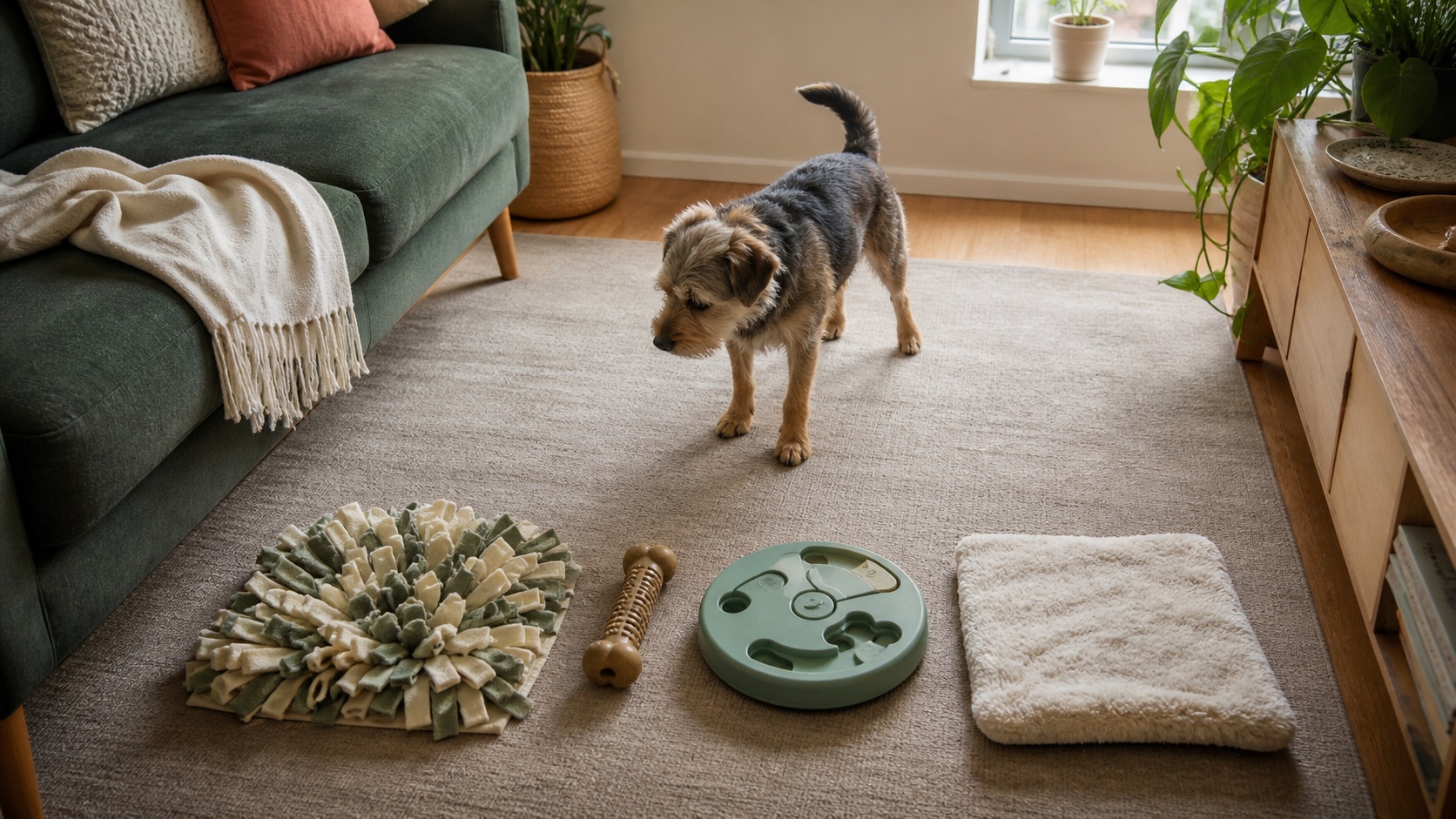
A yard is lovely, but it is not a personality trait—and your dog has not read the real-estate listing. Apartment dogs do not need a catalog of gadgets. They need repeatable ways to sniff, chew, think, move, and rest without turning the hallway into a tiny, highly opinionated obstacle course.
Enrichment, in the sense veterinary behaviorists use it, is not “more stimulation.” It is an appropriate outlet for species-typical behaviors: sniffing, searching, chewing, licking, problem-solving, moving, and—this is the part people skip—resting. A VCA client handout written by diplomates of the American College of Veterinary Behaviorists describes foraging toys as a way to give dogs mental and physical exercise by simulating hunting and seeking. The point is enjoyment and a legal job, not running a canine boot camp before dinner.
This guide will not fix separation panic, leash reactivity, or guarding. Those are behavior cases. If enrichment starts producing those problems, stop the new activity and use the training-or-help framework instead.
The apartment is a constraint, not a moral failing
Small space changes the logistics, not the dog’s need to do dog things. Square footage has never stopped a determined nose. You have less room to throw a ball. You have neighbors on the other side of the wall. You may have a single elevator, a single patch of grass, and a workday that does not care about your dog’s circadian rhythm.
What you still have:
- Meals you already pay for.
- A walk that can be a sniffing expedition instead of a forced march.
- Ten quiet minutes after coffee.
- Cardboard, towels, muffin tins, and a freezer.
- Permission to let the dog do nothing.
What you should not do is stack every trendy activity into one evening because the dog “has energy.” Over-arousal is not enrichment. A dog ricocheting off the sofa after a late wrestling session has been wound up, not helped.
The Four-Need Menu
Every ordinary day, try to hit four needs. You do not need four elaborate projects, matching storage bins, or a laminator. You need four useful checkmarks.
| Need | What it is for | Apartment-scale versions | Stop if |
|---|---|---|---|
| Sniff | The dog’s primary way of reading the world | A “sniffari” walk; kibble in a towel or snuffle mat; a new route around the block | The dog becomes frantic, overheated, or unable to disengage |
| Chew / lick | Oral settling, duration, quiet occupation | A stuffed and frozen food toy; a long-lasting chew the dog has used safely; licking a smear of wet food on a lick mat | Guarding, tooth-cracking hardness, swallowed pieces |
| Solve | Working memory, hunting sequence | A cardboard box with paper and a few kibbles; a beginner puzzle; a muffin tin with balls over food | Frustration, giving up, obsessive repetition |
| Rest | Recovery, feeling safe enough to sleep | A settled place away from the window; a routine after activity; permission not to perform | You are using “rest” to ignore a dog who cannot settle because of panic or pain |
That is the whole framework. Rotation lives inside the boxes, not as a fifth job.
A useful day for a typical adult apartment dog might look like this: morning sniff walk, breakfast from a simple food toy, a two-minute training game when you get home, a chew while you cook, and an evening that is allowed to be boring. The dog who can be bored without destroying the baseboards is a dog whose needs are mostly met.
Use the food you already serve
The easiest enrichment is not a purchase. It is breakfast—already in the budget and, according to most dogs, tragically underutilized.
Veterinary behaviorists at VCA recommend starting easy enough that the dog wins. A snuffle mat or a towel with kibble worked into the folds is a beginner’s foraging job: the dog sniffs and searches without having to shove a toy across a hardwood floor. A muffin tin with tennis balls over a few pieces of food is a homemade version of the same idea. Empty cardboard boxes and paper bags (handles removed, no staples, supervised) give a short hunting sequence and then go in the recycling.
Stuffable toys—rubber food toys you can smear and freeze—turn part of a meal into duration work. VCA’s difficulty ladder is practical: sticky food is easier; dry pieces in sticky food are harder; a firmly frozen stuffing is harder still. If the dog walks away, the toy is too difficult or the filling is not worth the effort. Make it easier. If the dog becomes frantic, same instruction.
Two rules keep this from becoming a mess:
Calories still count. WSAVA’s treats guide and the broader AAHA/WSAVA nutrition advice put extras—treats, chews, stuffing, training food—under about 10 percent of the day’s energy if they are not part of the complete diet. The cleanest method is to take the food out of the day’s ration. A “foraging breakfast” that is just the breakfast, served differently, does not require a second budget.
Supervision is not optional at first. VCA is explicit: size the toy so it cannot be swallowed; discard anything the dog is shredding into ingestible pieces; hard plastics and bones can fracture teeth. Multi-dog homes need gates. Food toys are valuable, and valuable things get guarded.
If the dog will not engage, try the toy when the dog is a little hungry, show that movement releases food, or put half the meal in a bowl and half in the toy and see which one the dog chooses. VCA also notes a medical caveat: a dog who starts, then suddenly stops, especially after bumping or lifting the toy, may be in dental or neck pain. That is a veterinary question, not a motivation lecture.
The ten-minute menu, for the day you actually have
You will not always have an hour. You will almost always have ten minutes, including the ten currently being negotiated away by your phone. Pick one.
The sniffari (10 minutes). Leave the house with no distance goal. Let the dog finish the smells that are not dangerous. You are still responsible for the leash and the crosswalk. You are not responsible for making the walk look athletic. For many dogs, this is the highest-value activity you can offer, and it requires no equipment.
The two-minute training pocket (2–5 minutes). Three cues the dog already knows, paid with breakfast kibble, in the kitchen. Hand target, settle on a mat, come from the bedroom. Short, clean, over. This is enrichment and relationship maintenance, not a career in obedience.
The box job (5–8 minutes). A shipping box, a handful of kibble, some crumpled paper. The dog hunts, you throw the box away. Do not use this with a dog who eats cardboard.
The settle chew (10 minutes of your time, longer of theirs). Stuff, freeze ahead, offer when you need the dog occupied. Frozen food toys can help apartment evenings stay quiet, which is enrichment for the dog and diplomacy for everyone sharing a wall.
The window audit (ongoing). A street-facing window can be enrichment or a rehearsal hall for barking. If the dog watches calmly and can disengage, fine. If the dog screams at every truck, covering the lower glass is management, and it is kind.
Rotate. Novelty matters less than fit. A dog who loves the sniffari does not need a new puzzle every Thursday. A dog who finds snuffle mats dull may love a cardboard search. The menu is a diagnosis of preference, not a shopping list.
Match the dog, not the internet dog
Puppies need short hunts, legal chewing, and sleep. They do not need an obstacle course in a studio apartment. Supervise every new object.
Seniors still benefit. VCA’s behaviorists note that senior dogs and cats show improved cognitive health when they regularly solve puzzles and do enriching activities, and AAHA’s 2023 senior-care work treats mental and physical stimulation as part of aging well, not as a luxury. Make the work easier: lower the toy, skip the jump, choose softer food, shorten the walk, add traction. A senior who cannot do stairs can still hunt kibble in a towel on the rug.
High-energy herding or sporting dogs in apartments need more sniffing and more legal jobs, not more chaos. A structured walk plus food work plus a training pocket will usually beat a late-night zoomie session that annoys the downstairs neighbor and leaves the dog electric.
Guarding, fear, or frustration change the menu. A dog who stiffens over a Kong needs separate space or a different activity, and possibly professional help. A sound-sensitive dog may find a plastic puzzle rattling on tile aversive; put a towel under it or pick another job. A frustrated barker at the window does not need “more to watch.”
Rest is a need. If the day’s plan is activity, activity, activity, you have built an athlete’s camp, not a household. Dogs should spend a large part of the day sleeping. An apartment dog who cannot settle may be under-exercised, over-stimulated, in pain, or anxious. Those are different problems. More fetch only solves one of them.
Safety that apartment people actually hit
- Ingestion. String, hair ties, kids’ toys, corn cobs, peach pits, xylitol gum on the coffee table. Enrichment should not add a foreign-body surgery. If it fits through the toilet-paper roll and is not food, it is probably not a toy.
- Noise. A bouncing food toy at 6 a.m. on hardwood is how you meet the condo board. Use a rug. Use a snuffle mat. Use a lick toy that stays put.
- Heat and elevators. Summer asphalt, closed stairwells, and mid-day sun on a west balcony are not enrichment. They are heatstroke risks. Cornell treats heatstroke as an emergency; panting, drooling, weakness, and collapse after heat or exertion are not “tired from a good walk.”
- Balconies and windows. Screens fail. Do not leave a dog unattended on a high balcony. Do not assume a window is safe because it is “only open a little.”
- Other dogs in the building. The elevator is not a social mixer. If your dog cannot think in that box, manage: wait for the next one, ride at off hours, teach an automatic settle facing you. That is training and management, not a failure of enrichment.
- Calories plus joints. A stuffed toy every night on top of full meals is how a small apartment dog becomes an overweight apartment dog. Weigh the dog. Look at the waist. Ask the veterinarian for a body-condition check.
A week you can actually repeat
Do not build a Pinterest calendar that requires craft supplies and a personal assistant. Build a default you can repeat on an ordinary Tuesday.
- Daily: one sniff-focused walk, at least one meal served in a way that takes longer than a bowl, one window of real rest.
- Most days: a two-minute training pocket.
- A few days a week: one slightly more interesting hunt (new route, box, or beginner puzzle).
- Always: one chew or lick option the dog already uses safely.
Put tomorrow’s version on the calendar as if it were a pill. The activity you will actually do counts; the magnificent enrichment plan living only in your notes app does not.
If the dog is destroying doors, howling for hours, or cannot be left with any object, enrichment is not the first tool. Safety management and qualified help are. A better puzzle will not treat panic.
Pick one repeatable activity your dog enjoys. Serve it from the existing meal. Do it tomorrow. Then do it again.
Reader tool: the Four-Need card
At the end of the day, mark four boxes. If a box is empty two days in a row, that is the one to fix—not the one to decorate.
- [ ] Sniffed (walk or search)
- [ ] Chewed or licked something legal
- [ ] Solved one easy problem
- [ ] Rested in a place that feels safe
Budget check: extras stayed inside the day’s food or under the treat allowance. Nobody got hurt. Nobody guarded. The downstairs neighbor still likes you.
Evidence trail
Sources and further reading
- VCA Animal Hospitals — Behavior Management Enrichment And Activity Toys
- wsava.org — Feeding Treats To Your Dog V2.Pdf
- pmc.ncbi.nlm.nih.gov — Pmc11945345
- American Animal Hospital Association — 2023 Aaha Senior Care Guidelines For Dogs And Cats
- American Animal Hospital Association — Optimizing The Golden Years
- vet.cornell.edu — Heatstroke Medical Emergency
- avsab.org — Avsab Humane Dog Training Position Statement 2021.Pdf
- pmc.ncbi.nlm.nih.gov — Pmc7222336