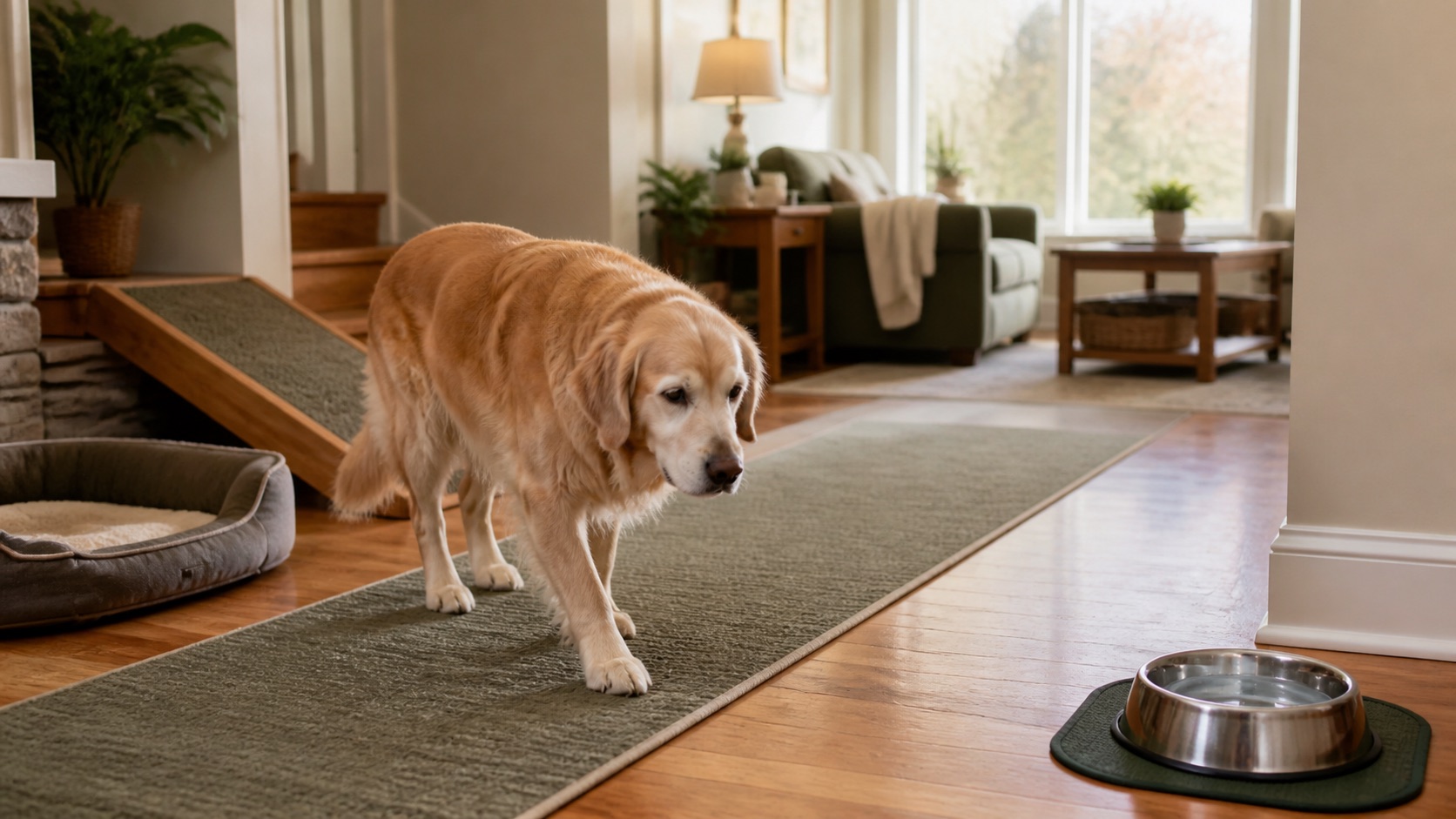
As dogs age, changes in mobility, comfort, senses, sleep, and behavior can make familiar parts of the home harder to navigate. It is a shifting set of abilities inside a house that was built for a younger dog. The kindest thing you can do this month is not to buy a product. It is to walk the path your dog already walks and remove one avoidable obstacle.
The American Animal Hospital Association’s 2023 Senior Care Guidelines exist because families still treat decline as destiny. AAHA’s public abstract is the sentence to keep: old age is not a disease. Pain, dental disease, osteoarthritis, sensory loss, metabolic disease, and cognitive change are medical and environmental problems. Some of them can be helped. None of them is solved by an internet supplement stack.
This guide will not diagnose arthritis or cognitive dysfunction. It will not tell you to start a medication. It will give you a route-based audit, a way to date what you see, and a clear line between a home adjustment and a veterinary visit.
Start with the route, not the catalog
Most senior-home advice is a pile of objects: ramp, rug, night light, raised bowl. Objects are useful only if they sit on the path the dog actually uses.
Tomorrow morning, before you rearrange anything, follow the dog with a notebook. Start where the dog sleeps. Then go, in the dog’s order, to water, to the door used for toileting, to the feeding spot, to the favorite rest place, and back. That loop is the Daily Route. If the dog has a second loop at night, walk that too.
On each segment, ask four questions:
- Traction. Does the dog slip, splay, or hesitate?
- Access. Is there a jump, a turn, a lip, a stair, or a piece of furniture the dog must negotiate?
- Light and contrast. Would you trust this path in socks at 2 a.m.?
- The dog’s opinion. Does the dog pause, choose a longer way, or stop offering a behavior they used to do?
AAHA’s senior-care chapter on evaluating the healthy senior pet asks clinicians to take a history of eating, drinking, exercise, movement, play, eliminations, attitude, grooming, vision, and hearing, and it specifically values client videos of the animal moving at home. Your route walk is that video’s scouting trip. Date it.
What aging can look like at home
You are collecting signs, not naming diseases.
Cornell’s owner materials on recognizing pain point to changes in posture, stiffness, trouble rising or climbing, restlessness, and a lower willingness to do familiar things. A dog who used to take the sofa in one motion and now stands in front of it is giving you data. So is a dog who no longer greets at the door, who paces at night, who startles when approached from sleep, or who has begun to soil indoors.
AAHA notes that client videos of ambulating or jumping can help detect early neuropathic or musculoskeletal disease that a tense clinic exam may miss. A 20-second clip of the dog rising from the bed and turning toward the water bowl is worth more than the sentence “he’s just slowing down.”
Cognitive change—disorientation, altered sleep-wake cycles, house-soiling, and changed social interaction—is real in some older dogs and is discussed in AAHA’s senior-care materials as something to assess and manage, sometimes with environmental enrichment, diet, and, when a veterinarian judges it appropriate, medication. You cannot sort “cognitive” from “painful” or “losing hearing” from a checklist. You can date the behaviors and take them in.
Thirst, appetite, weight, and bathroom habits belong in the same notebook. A new accident may be mobility (cannot get to the door in time), sensory (cannot find the door at night), pain (does not want to rise), medical (many possibilities), or cognitive. The house can help with the first three. It cannot tell you which one you have.
Room by room, only where the route goes
Audit the rooms on the Daily Route. Skip the guest room the dog never enters.
Sleeping place. Is the bed stable, or does it slide on hard floor when the dog climbs out? Is the foam collapsed in the middle so the dog has to climb a valley? Can the dog step onto it without jumping? A low, wide, high-friction bed on a non-slip pad is often more useful than a plush cave the dog has to duck into.
Path to water. Water should be where the dog can reach it without a circus act, and it should be heavy enough not to chase around the room. If vision is changing, a dark bowl on a dark floor is a disappearing trick. Contrast helps. So does a second bowl so the dog does not have to cross the house when stiff.
Door to outdoors. This is the most important ten feet in many homes. Slippery tile by the back door is how older dogs go down. A securely anchored runner, a rug with a non-slip backing, or—if you rent—a removable traction strip can change a daily fear into an ordinary exit. Give the dog time. A senior who used to bolt out may now need the door held and a moment to arrange the feet.
Stairs. Stairs are optional for people and mandatory for some floor plans. If the dog still uses them, light them, keep them clear, and consider a runner if the surface is slick. If the dog is starting to fail them, manage: baby gate, carry when safe for your back, or relocate the Daily Route to one floor. Do not cheerlead a dog up a staircase they no longer trust.
Feeding area. AAHA is clear that an older dog doing well on a complete adult diet does not automatically need a “senior” food. Raised bowls help some dogs with neck or limb pain and make other dogs eat in an awkward stance. Watch the individual. If you raise the bowl, make it stable. If appetite is dropping, or the dog approaches food and then walks away, think mouth pain and nausea before you think pickiness, and call the veterinarian.
Favorite furniture. Sofas and beds are jumps. If the dog still insists, a low, wide ramp or steps with traction may help. If the dog has started to refuse, believe them. Blocking access is kinder than an orthopedic emergency.
Floors. Hardwood, tile, and vinyl are ice rinks for many older dogs, especially after a nail trim or on wet paws. You do not need to carpet the house. You need a continuous, non-slip path along the Daily Route. Rugs that bunch are worse than no rug. Tape or pad them, or replace them.
Light. Night-pacing dogs and dogs with poorer vision do better with a dim, consistent path light than with a dark hallway and a sudden overhead glare. Keep furniture in predictable places. Rearranging the living room for a party is a bigger deal than it used to be.
Sound and startle. Hearing loss turns a tap on the rump into a jump-scare. Approach where the dog can see you. Thump the floor softly. Do not sneak up to be tender.
Toileting. Shorter warning time plus slower travel means more accidents. Add an outing. Add a closer door if you have one. For some dogs, a belly sling on slick steps is the difference between a clean night and a fall. Indoor options exist; they are management, not a moral event. Any sudden incontinence still belongs in a veterinary conversation.
Zoetis’ veterinary-team summary of the 2023 AAHA Senior Care Guidelines, aimed at helping clinics coach families, lists the same practical home moves: ramps or pet stairs, non-slip rugs, and fewer chaotic disruptions for dogs with reduced vision or mobility. That is not product advertising. It is environmental medicine.
The Daily Route scorecard
Walk the route. Score each segment 0, 1, or 2.
| Score | Meaning |
|---|---|
| 0 | The dog moves through without hesitation, slip, or extra steps. |
| 1 | The dog hesitates, takes a longer path, or you see a minor slip or awkward turn. |
| 2 | The dog refuses, falls, cries, or cannot complete the segment without help. |
Write the date, the segment (bed → water, water → door, and so on), the score, and one concrete note: “hind feet slide on kitchen tile,” “pauses at sofa,” “will not do back stairs after dark.”
Then pick the highest score you can actually change this week. One runner by the door beats a shopping cart of unused ramps. Re-walk the same route in two weeks. If scores rise despite your changes, or any segment is a 2, call the veterinarian and bring the card and a video.
That scorecard is the original tool. It is deliberately boring. Boring is how you notice change.
What you may adjust at home, and what you may not
You may:
- Add traction on the Daily Route.
- Lower or stabilize beds and bowls.
- Light the night path.
- Move food, water, and sleep onto one floor.
- Shorten jumps.
- Offer more frequent toilet breaks.
- Keep the furniture layout predictable.
- Continue gentle, veterinarian-approved movement. Complete rest is not automatically kind to arthritic dogs; the right movement plan is a clinical question.
- Keep the mind in the game with easy foraging, short training, and sniff walks adjusted to the dog’s body. AAHA treats environmental enrichment as part of senior care, not as an extra.
You may not:
- Start a pain medication, anti-inflammatory, or “just a little” human drug because a group recommended it. AAHA warns specifically about drug and nutraceutical interactions—including combinations that can contribute to gastrointestinal bleeding or serotonin syndrome—and about products that look harmless because they are labeled natural.
- Change to a new diet, especially a homemade or heavily supplemented one, without veterinary guidance. There is no single AAFCO senior nutrient profile. The right food depends on the dog’s actual conditions.
- Assume a limp is “just arthritis.”
- Delay care because you do not want to be “that owner.”
AAHA recommends a thorough senior evaluation, and many clinics will suggest more frequent visits and laboratory screening as dogs age. How often is a decision between you and the veterinarian, not a number this article should invent. What you can do is arrive with a dated route card, a medication list that includes the joint chew and the calming oil, and two videos: one of rising, one of the door.
When the house is not the problem
Call promptly—using the observation brief in our veterinary-visit guide—if you see sudden inability to walk, a dragging limb, a cry of pain, a bloated belly, collapse, breathing change, or a dog who cannot rise. Those are not home-audit findings.
Call soon for progressive stiffness, new accidents, new night-pacing, new thirst, weight loss or gain you cannot explain, a mouth that smells newly foul, or a dog who seems lost in the house. Bring the dates. “Started the week of June 2, worse on tile, better on carpet, video on my phone” is a gift to the clinician.
If behavior has changed—irritability, new guarding, panic when left—do not correct it as a manners problem until pain and medical causes have been considered. The training-or-help guide starts with that same gate.
A ten-minute audit you can finish today
- Walk the Daily Route once with a notebook.
- Score each segment.
- Remove or pad the single worst slip or jump you can fix without tools.
- Film the dog rising and walking to the door.
- Write a medication-and-supplement list.
- Book or wait for the next veterinary visit with those three things in your pocket.
Choose one room. Remove one avoidable obstacle. Date what you notice. That is the whole ethic: the house should not be harder than the day already is.
Reader tool: the Daily Route card
Date: __________
Dog: __________
Route: bed → water → door → bowl → rest → (night path)

Segment              Score 0/1/2    Note
bed → water
water → door
door (outside/in)
door → bowl
bowl → rest
night path

Highest score this week: ______
One change I will make: ______
Video taken? yes / no
Vet share date: ______Evidence trail
Sources and further reading
- American Animal Hospital Association — 2023 Aaha Senior Care Guidelines For Dogs And Cats
- American Animal Hospital Association — Evaluating The Healthy Senior Pet
- 24051120.fs1.hubspotusercontent-na1.net — Senior Care Guideline 321 Sheet.Pdf
- zoetisus.com — Senior Dog Care Tips For Clients And The Vht
- American Animal Hospital Association — Age Specific And Breed Specific Diets
- vet.cornell.edu — Recognizing Pain Dogs
- American Animal Hospital Association — Optimizing The Golden Years
- VCA Animal Hospitals — Behavior Management Enrichment And Activity Toys